On this page
Before leaving for the CFP® exam, check that your photo ID matches your registration, your financial calculator is permitted and working, and your route gets you to the test site early enough for check-in. Decide in advance what will stay in the locker and how you will use the scheduled break. CFP Board's current exam-day page and candidate handbook are the controlling sources for the details, so recheck them against your own appointment instructions.
Confirm identity and the appointment
CFP Board's July 2026 candidate handbook says to report to the examination site thirty minutes before the scheduled appointment. That is a reporting time, not a suggestion to begin travelling thirty minutes before the exam. Build a route that leaves room for transport disruption and for locating the entrance. Check your exact site and appointment in the confirmation you received, because a general exam-day article cannot verify an individual's booking. CFP Board's exam-day strategies page likewise advises planning travel and arriving thirty minutes ahead.
Bring a valid, unexpired government-issued photo ID with a name matching the name under which you registered. CFP Board's exam-day rules allow common nickname variations, but that is a narrow example, not permission to assume that any discrepancy will be accepted. Check the name now, before the day becomes a check-in problem. If a name or ID issue is uncertain, resolve it with the exam administrator through the official channel in advance rather than relying on a proctor to make an exception at the desk.
At the site, CFP Board says the administrator verifies the ID, captures a photograph and fingerprints, and conducts a body scan. Personal belongings go into an assigned locker. This sequence takes time and can feel unfamiliar, which is why arriving ahead matters. Treat the ID as something you will need again when returning from a break: the handbook says candidates must pass security checks and present valid ID for readmission. Put it where you can retrieve it easily from the locker without risking it being left behind.
Check the calculator before packing it
The calculator must be a battery-powered, non-programmable, dedicated financial-function model accepted under CFP Board's calculator policy. The policy has an explicit model list; a calculator that merely performs financial calculations is not automatically accepted. Match the exact model and version to that list before exam day. Bringing one or more permitted calculators is allowed, so a checked spare can reduce disruption if a device fails, but a spare is useful only when it too meets the policy.
Replace or test the batteries in good time. CFP Board allows loose spare batteries without packaging in the testing room, and advises testing fresh batteries before the examination. Check the calculator's display, keys and settings while there is still time to solve a problem. The administrator inspects calculators, and candidates must clear calculator memory before each exam section. CFP Board says candidates themselves are responsible for restoring their desired settings after the clear; the test-centre staff will not do that task for them. Practise the memory-clear and setup sequence on your own permitted model beforehand, using the maker's instructions where necessary.
Check the back of the device as carefully as the front. CFP Board's policy says notes, printed formulas, pull-out cards and other supplemental material on a calculator must be removed or masked with solid-colour tape before entering the testing room. A handwritten reminder you rely on while studying is precisely the sort of item to remove. Do not improvise a covering at the test site. Put the approved, clean device and loose batteries together with the ID so the morning checklist has only a few physical items.
Decide what stays outside the room
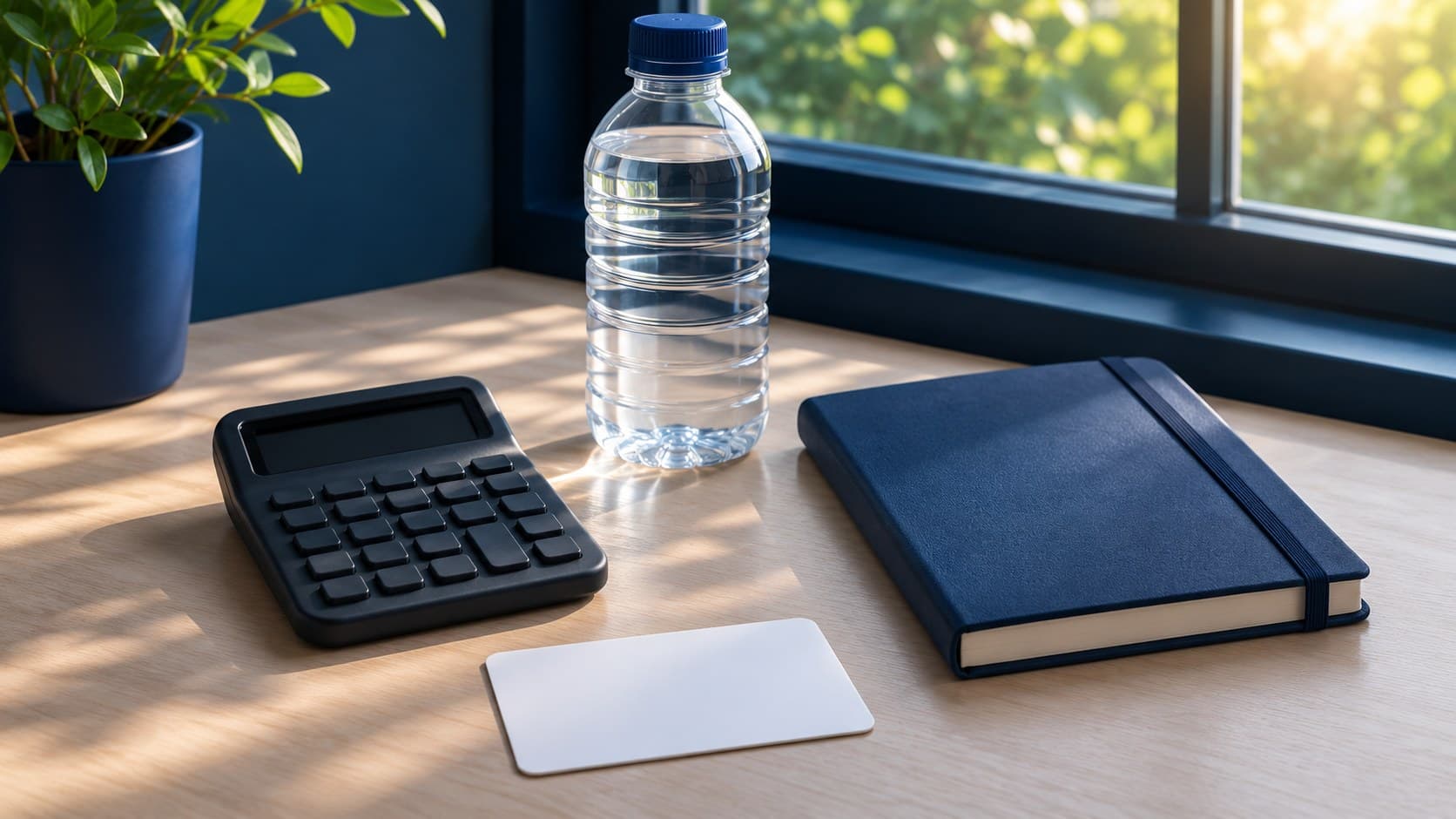
CFP Board permits a clear bottle of water with its labels removed in the exam room. Food, other drinks and notes cannot be brought into the room under the handbook rules. The public exam-day page says food, water and notes may be brought to the site for locker storage, with locker access during the scheduled break. It also states that electronic devices other than an acceptable calculator cannot be accessed while testing is in session; storing a phone in the locker does not make it a break-time study tool. Follow the administrator's instructions at the site if they are more specific about storage and access.
Scratch paper is provided by the centre, along with pencils under the handbook. Notes made on it are collected and may not leave the room. The administrator can also provide noise-cancelling headphones on request, according to CFP Board's public exam-day page. That means a candidate need not pack personal scratch paper or assume personal headphones may enter. Before check-in, empty pockets of items that are easy to forget, including a phone or written study note, so the security process is straightforward. These are operational safeguards, not substitutes for knowing the exam material.
Make a break plan that respects the clock
CFP Board describes the exam as two three-hour sections with a scheduled forty-minute break between them. Each section has two subsections. Optional breaks can occur between subsections, but the section timer continues during those optional breaks. When a subsection is finished and the next begins, candidates cannot return to the earlier subsection. The scheduled break is different: the handbook says the next section begins when the forty minutes end, whether or not the candidate has returned to the workstation. Those timing distinctions matter more than a generic instruction to “take breaks”.
Consider an illustrative, non-prescriptive schedule. If a candidate's first section finishes at midday, the scheduled break would run for forty minutes. The candidate would need to retrieve permitted food, use facilities and pass re-entry checks within that interval; sitting down at the last moment risks losing time when the next section starts. This is a worked planning scenario, not a statement about a particular appointment's start time. For an optional midsection break, the cost is time from the same section's timer, so decide whether a short pause is worth the remaining time before leaving the desk. CFP Board's exam format page confirms the two sections and optional breaks.
A practical contingency check is to separate problems by when they can still be solved. A questionable ID name or calculator model calls for verification with the official exam administrator before travel; it is difficult to repair at check-in. A flat calculator battery can be addressed in advance by testing it and preparing permitted loose spares. An uncertain route can be checked against the appointment confirmation and mapped before leaving. Once inside the centre, the administrator controls the security process, so ask about any unclear instruction before moving between the locker and testing room. During the scheduled break, keep track of the return time and allow for another security check. The purpose of this sequence is to reduce avoidable operational surprises, not to imply that every problem has an on-site exception. CFP Board’s published rules, together with the candidate’s own confirmation, should settle the details that matter for that particular sitting.
The easiest rehearsal is physical rather than abstract. Lay out the ID, calculator and any permitted loose batteries, then compare each item with CFP Board’s written rules. Put food and notes in a separate group for locker use, and remove labels from any clear water bottle intended for the exam room. Keep the appointment confirmation available for travel and check-in, but expect to store any electronic device according to site instructions. This rehearsal exposes a wrong calculator version, an expired ID or a forgotten pull-out card while there is still time to address it. It also prevents a candidate from assuming that because an item may be brought to the site it may be used at the workstation. On arrival, follow the administrator’s direction for the actual room and locker. The published policy answers what is generally allowed; the administrator manages the on-site security sequence.
Avoid confusing this logistics plan with question pacing. Another Omni article on CFP exam pacing deals with allocation of question time; this one is about admission, permitted objects and the consequences of leaving the room. The CFP programme page provides broader study context. On the evening before the appointment, put the checked ID and calculator together, confirm transport and site details, and choose what food or water will be stored. On the morning, recheck the appointment and allow the handbook's reporting window. That leaves fewer avoidable decisions to solve under pressure at the test centre.
Sources
- What to Expect on Exam Day | CFP Board · cfp.net · Retrieved
- CFP Exam Candidate Handbook, July 2026 | CFP Board · cfp.net · Retrieved
- Calculator Policy | CFP Board · cfp.net · Retrieved
- Exam Format | CFP Board · cfp.net · Retrieved
- Exam Day Strategies | CFP Board · cfp.net · Retrieved