Skip to content

CFA Level I study notes, mapped to every LOS

The full Level I curriculum condensed into source-cited notes — one per reading, each opening from its learning outcome and carrying an Evidence Panel of difficulty, pitfalls, and exam frequency.

  • Source-cited
  • LOS-mapped
  • Evidence Panel on every reading

580+

Learning outcome statements

~300 hrs

Recommended study time

4×/year

Sittings · Feb · May · Aug · Nov

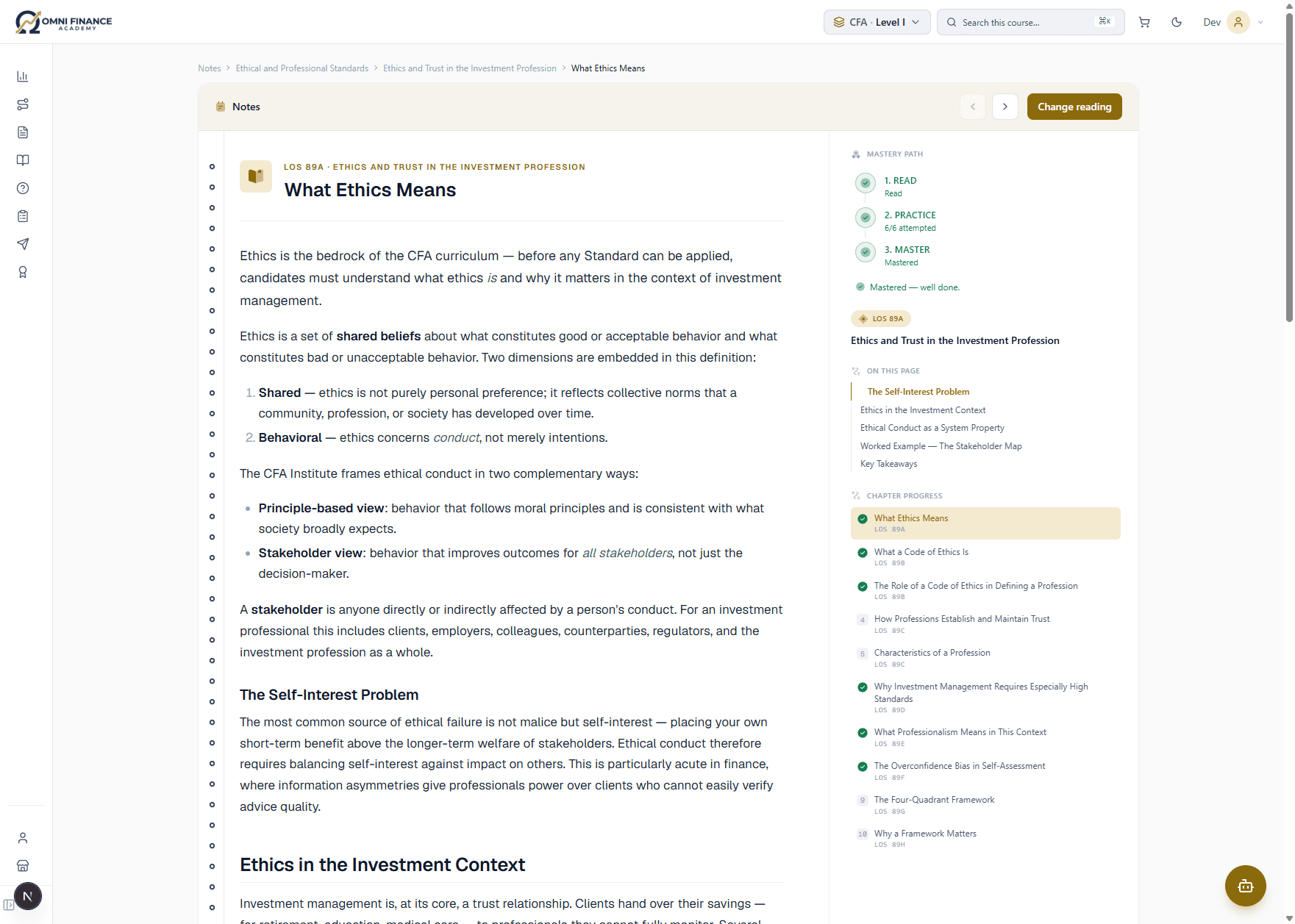
Omni Finance Academy study note reading view

Notes that earn their place in your day

  1. 01

    Mapped to every LOS, cited to the curriculum

    Each note opens from a learning outcome statement and closes with its source citation. You always know what the reading asks you to be able to do, and where the claim comes from.

  2. 02

    An Evidence Panel on every reading

    Candidate-reported difficulty, the pitfalls that trip people up, and how often the topic appears — surfaced on the reading so you spend your hours where the exam does.

  3. 03

    Condensed, not compressed

    We cut the textbook padding, not the substance. The notes are short enough to revise in a sitting and complete enough that you are not forced back into 3,000 pages of curriculum.

See a real note

This is an actual CFA reading as it appears in the platform — the learning outcome, the Evidence Panel, the key points, the pitfalls, and the source citation. No teaser blur.

LOS 1.aQuantitative Methods · Time Value of Money

Interpreting interest rates and discounting

Difficulty

Candidate-reported: Moderate

Exam frequency

High — appears on essentially every Level I sitting

An interest rate can be read three ways at once: as a required rate of return, as a discount rate, and as an opportunity cost. The same number does all three jobs — which reading you use depends on the question being asked.

Key points

  • The nominal risk-free rate ≈ real risk-free rate + expected inflation; adding default, liquidity, and maturity premiums builds it up to a required return.
  • Present value discounts a future cash flow; future value compounds a present one. They are the same equation rearranged.
  • More frequent compounding raises the effective annual rate (EAR) for a given stated rate — EAR = (1 + periodic rate)^m − 1.

Common pitfalls

  • Mixing the compounding frequency of the rate with the frequency of the cash flows — always match periods first.
  • Quoting a stated annual rate where the question wants the effective annual rate.

Source: CFA Program Curriculum, Level I — Quantitative Methods, Time Value of Money.

Get the notes — and everything else

The notes ship in every plan. Pick how far you want the rest of the toolkit to take you.

About the study notes

They are a complement, not a replacement. We cite the official curriculum and recommend reading it; the notes sit on top with the condensation, evidence, and pacing the official materials do not provide.

Study CFA Level I the evidence-led way

Start with one full topic free — read a real note before you decide.