Skip to content

CFA Level III study notes for the advisor’s exam

Portfolio-management-first notes that frame each outcome the way Level III asks it — as a recommendation to justify, not just a fact to recall. Cited to the curriculum, with an Evidence Panel on every reading.

  • Source-cited
  • LOS-mapped
  • Evidence Panel on every reading

310+

Learning outcome statements

~350 hrs

Recommended study time

Essay + item-set

Constructed-response exam

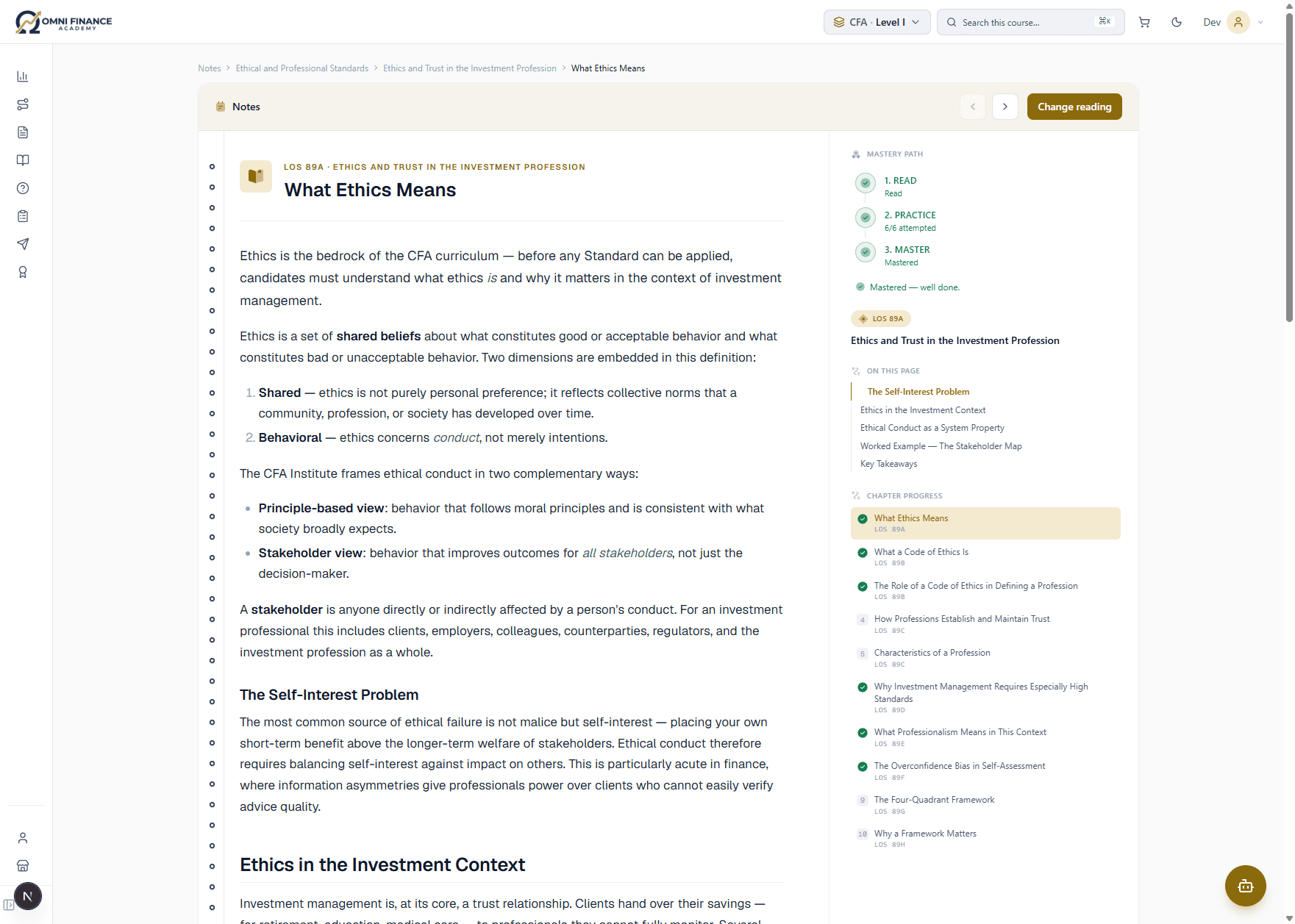
Omni Finance Academy study note reading view

Notes that earn their place in your day

  1. 01

    Mapped to every LOS, cited to the curriculum

    Each note opens from a learning outcome statement and closes with its source citation. You always know what the reading asks you to be able to do, and where the claim comes from.

  2. 02

    An Evidence Panel on every reading

    Candidate-reported difficulty, the pitfalls that trip people up, and how often the topic appears — surfaced on the reading so you spend your hours where the exam does.

  3. 03

    Condensed, not compressed

    We cut the textbook padding, not the substance. The notes are short enough to revise in a sitting and complete enough that you are not forced back into 3,000 pages of curriculum.

See a real note

This is an actual CFA reading as it appears in the platform — the learning outcome, the Evidence Panel, the key points, the pitfalls, and the source citation. No teaser blur.

LOS 6.aPortfolio Management · Asset Allocation

Liability-relative vs asset-only allocation

Difficulty

Candidate-reported: Hard

Exam frequency

High — a Level III asset-allocation anchor

Whether you optimise assets in isolation or relative to liabilities is the first decision in any Level III allocation question — and it is driven entirely by whether the investor has explicit liabilities.

Key points

  • Asset-only mean-variance optimisation ignores liabilities; appropriate for investors without defined obligations.
  • Liability-relative (surplus) optimisation manages assets − liabilities, the right lens for DB pensions, insurers, and banks.
  • Goals-based allocation segments wealth into sub-portfolios by goal and priority — the individual-investor analogue of liability matching.

Common pitfalls

  • Recommending asset-only MVO for an investor with explicit liabilities (e.g. a DB plan) — surplus risk, not asset risk, is what matters.
  • Treating goals-based and liability-relative as unrelated — both anchor the allocation to obligations rather than to assets alone.

Source: CFA Program Curriculum, Level III — Asset Allocation, Overview of Asset Allocation.

Get the notes — and everything else

The notes ship in every plan. Pick how far you want the rest of the toolkit to take you.

About the study notes

Yes. Level III notes frame outcomes as recommendations to justify, and the question bank drills the command-word discipline the essay session rewards.

Study CFA Level III the evidence-led way

Start with one full topic free — read a real note before you decide.